
10 Best Digital Marketing Gamification Examples
April 30, 2026
Words by Jeff Cardello
Traditional marketing is a one-way form of communication. Print, radio, and television advertisements cast wide nets, hoping to capture the attention of whoever they can. Today, digital marketing allows for far more precise targeting. When someone visits a website, they have a reason for being there, and gamified campaigns invite them to interact further and take in the messaging or information a brand wants them to know.
Gamified experiences are important in making people happy. From product matching quizzes to video games we’re going to show you ten different gamification examples, discuss how gamified campaigns capture people’s attention, get them to engage, and reward them for visiting.
1. Sephora Cosmic Shelter
When you think of Sephora, words like beauty and elegance come to mind. But pinball? Sephora delivers the unexpected with a virtual arcade game that evokes the same sense of lush sophistication. Filled with the richness of cherry reds, lightness of pinks, the muted glow of neon, and the motion of real-world physics, it’s a beautifully rendered 3D experience.
Sephora highlights its cosmetics by placing them on the playfield, where hits make them jump and flash. Phrases like “Still ultra matte” and “Still ultra pigmented” also appear, delivering more subtle marketing. It’s a clever example of gamification in marketing that brings together action-packed gameplay, glamour-inspired visuals, and branding into what feels more like fun than self-promotion.
And while Sephora’s pinball game is a blast to play, research shows that gamification leads to better engagement. Gamification case studies like the 2018 paper by Hsu and Chen found that gamification leads to more positively viewed user experiences and helps build brand loyalty. Whether you’re a marketer or a designer, you’ll find it one of the most detailed gamification case studies in understanding how it works and its benefits.
And while you can’t create games with them (yet), you can add 3D graphics and animated interactions to websites built with Vev using tools like Rive and Spline that can mimic the action of video games.
2. Lunchbox Death Chef
While Lunchbox is in the serious business of providing restaurants with digital tools in streamlining their work, Death Chef shows that they’re not afraid to get a bit silly. In this Space Invaders style shooter Death Chef must hurl knives at advancing sharks, cows, and chickens who launch projectiles like eight balls and cow patties. It’s always nice to see gamification examples where brands give visitors something that’s just for the joy of playing.
If you want to try something similar on your own website, Vev’s Embed Anywhere feature comes in handy when used with no-code game builders like GDevelop, which lets you build games powered by HTML5 and JavaScript that are fairly simple to integrate.
3. Adult Swim Rick Yourself
Adult Swim’s Go Rick Yourself avatar generator fits right in with Rick and Morty’s bizarro animated multi-verse. With interchangeable heads, eyes, noses, and bodies, you can play it safe and make a character that looks like yourself, or go full-on interdimensional alien. Either way, it’s a playful activity that lets fans become part of the show and share their creations on social media.
Gamified campaigns like Go Rick Yourself are effective in building brand awareness organically. Fans not only get something out of assembling custom characters, but Adult Swim also benefits from the user-generated content that gets out to more people, inspiring those with the same offbeat sense of humor to watch.
4. Code Academy
If you want to pursue a career in tech it can be difficult to know where to start. You might love the analytical problem-solving of data science. Or maybe the multifaceted job of full-stack developer might be more your thing. Code Academy knows the challenges of finding the right learning path, and helps prospective students with its What’s Your Programming Personality quiz. And these aren’t boring questions. You're asked about topics like what kinds of movies you like, how you solve problems, and other questions that really get into who you are and how you think.
Whether you’re selling a physical product or a course, people often need guidance. Quizzes and other interactive content examples are effective forms of digital marketing gamification that work well in personalizing the decision-making process.
If you want to construct your own customer quizzes or personality tests, Vev makes it easy to build and style them so they fit seamlessly into a web design.
Gamification is a big part of Code Academy and all over the realm of online learning. And while Duolingo has been covered by so many others, we wanted to point you to their piece Duolingo 101: How to learn a language on Duolingo, which is one of the most insightful gamification case studies out there. It breaks down how they use experience points, streaks, and interactivity that keeps people motivated and inspired to keep learning.
5. Vev 404 Page
We expect gamification examples that have clear rules or rewards. But not every piece of interactive content needs to be driven by extrinsic motivation.
Like the page of a blank sketchbook, Vev’s 404 page offers visitors the chance to scribble whatever they want. Whether you want to scribble stick figures, draw flowers, or challenge a friend to tic-tac-toe, the choice is yours.
6. Urban Ministries of Durham Spent
While digital marketing gamification is often associated with retail brands, nonprofit organizations also use it to raise awareness about the causes they support and the importance of what they do.
Urban Ministries of Durham helps out those going through financial hardships. Their interactive story Spent simulates how fast it is to go through $1000.00 when faced with expenses like health insurance, overdraft fees, and unexpected expenses. It’s a sobering experience, showing the realities of poverty. It’s one of the most powerful gamification examples we’ve come across that brings attention to a humanitarian problem and builds empathy towards those going through tough times.
7. Your Skin
One of the best parts of going into a store is talking to employees who can point you towards the products that fit what you're looking for. It can be difficult to replicate in-store experiences to those that are digital, but marketing engagement strategies like quizzes can give customers the attention and information they need to help them decide on what they should buy.
While many gamification examples like quizzes follow a linear structure, Your Skin helps people find skin-care products through a survey where each question depends on how the previous one was answered. This logic branching feels like an actual dialog where customers’ needs are heard, they get product recommendations, and can then make an informed choice about what to purchase.
8. Skittles Crunch Acceptance
We know all about Skittles and their tagline, “Taste the Rainbow”. But did you know that they have a line of multi-colored candies with crispy bits of freeze-dried embedded inside? For those who think regular Skittles aren’t enough sugary goodness, there’s now Skittles Pop’d.
With Skittles putting out off-beat Tik Toks of young people’s faces taking on unnatural expressions while eating Skittles Pop’d it’s easy to see that they’re targeting Gen-Z or younger. This isn’t candy for those who reach for something more conventional like a Werther’s Original hard candy, but for those youthful thrill seekers who want to send their taste buds into hyper-drive.
Skittles’ Find Crunch Acceptance campaign fits right into the youth-centered vibe they’re going after. At the top you’re greeted by an avatar with a buzz cut making the same weird and exaggerated faces seen in their TikToks. Depending on how you answer a few questions asking how you’re feeling, you’re sent off to random activities like flipping a coin or getting “hypnotized”. It’s weird. It’s pointless and taps right into the cringe comedy that young people find funny.
While you might think that this is one of the weirdest and joyfully pointless gamification examples, it all leads somewhere: a clear call to action that shows you where to find Skittles Pop’d.
9. Lipton Find Your Lipton Match
Gamification in marketing can also give brands that much-needed pizzazz that endears them to customers.
Lipton’s Iced Tea Quiz: Find Your Lipton Match has an upbeat color scheme that feels like the refreshment that comes from drinking a lemony iced tea by the pool on a warm summer day. Along with a bright and sunny design, there’s plenty of humor with meme references, puns, and other lighthearted writing that makes it a joyful experience to move through. Interactive content examples like Lipton’s show how important it is for quizzes to go beyond being a dry list of questions, but to give visitors experiences that capture a brand’s personality.
Marketing engagement strategies like quizzes are such a great way to get people excited about products, and Lipton succeeds by matching customers with the beverages they would be most likely to enjoy.
10. Dolce and Gabbana Lip Stylo
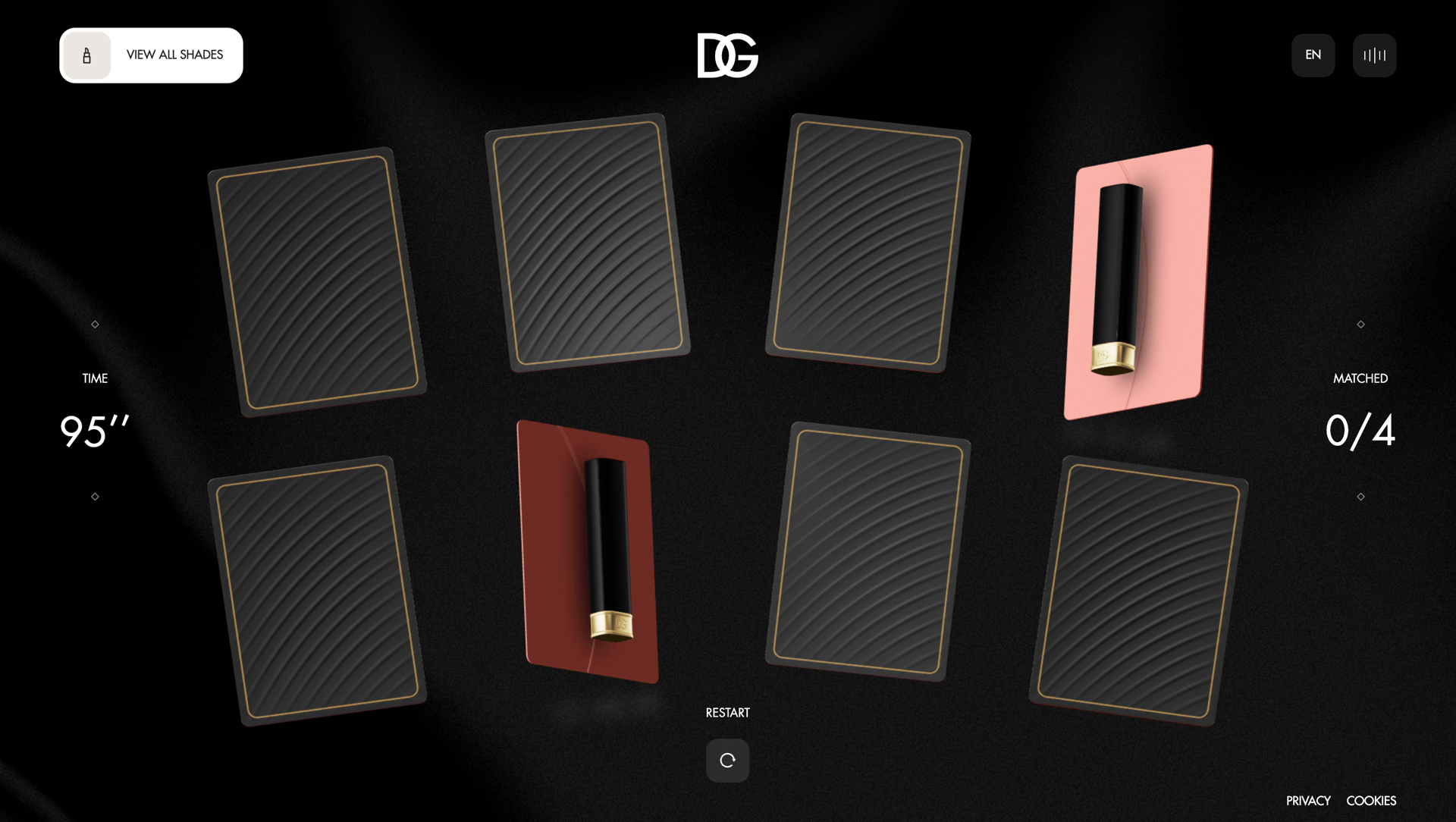
Dolce and Gabbana put your powers of recall to the test with this Lip Stylo matching game. It’s a brilliant example of gamification in marketing, where the whole point is to make products memorable. Winning the game shows you the four Lip Stylo shades that caught your eye, and the chance to learn more about them.
Create Your Own Gamified Content with Vev
Whether you want to create personality quizzes, product recommendation flows, add video game mechanics, or other interactive content examples, Vev gives you the tools to create, without having to enter a single line of code. Whether you’re a marketer or designer, Vev lets you design and collaborate on gamified campaigns, all in a single unified platform.
Are you ready to add gamification to your web designs that will help you better connect with customers?