Find out if you've won Vev "Project of the Month".
Vev Awards is the web design award where creativity matters. Each month, Vev users can submit their projects and our panel of experts at Vev HQ will create a shortlist from which a winner will be chosen. Any projects submitted after deliberation will be considered for the following month's awards.
Without further ado, let's take a look at the winner...


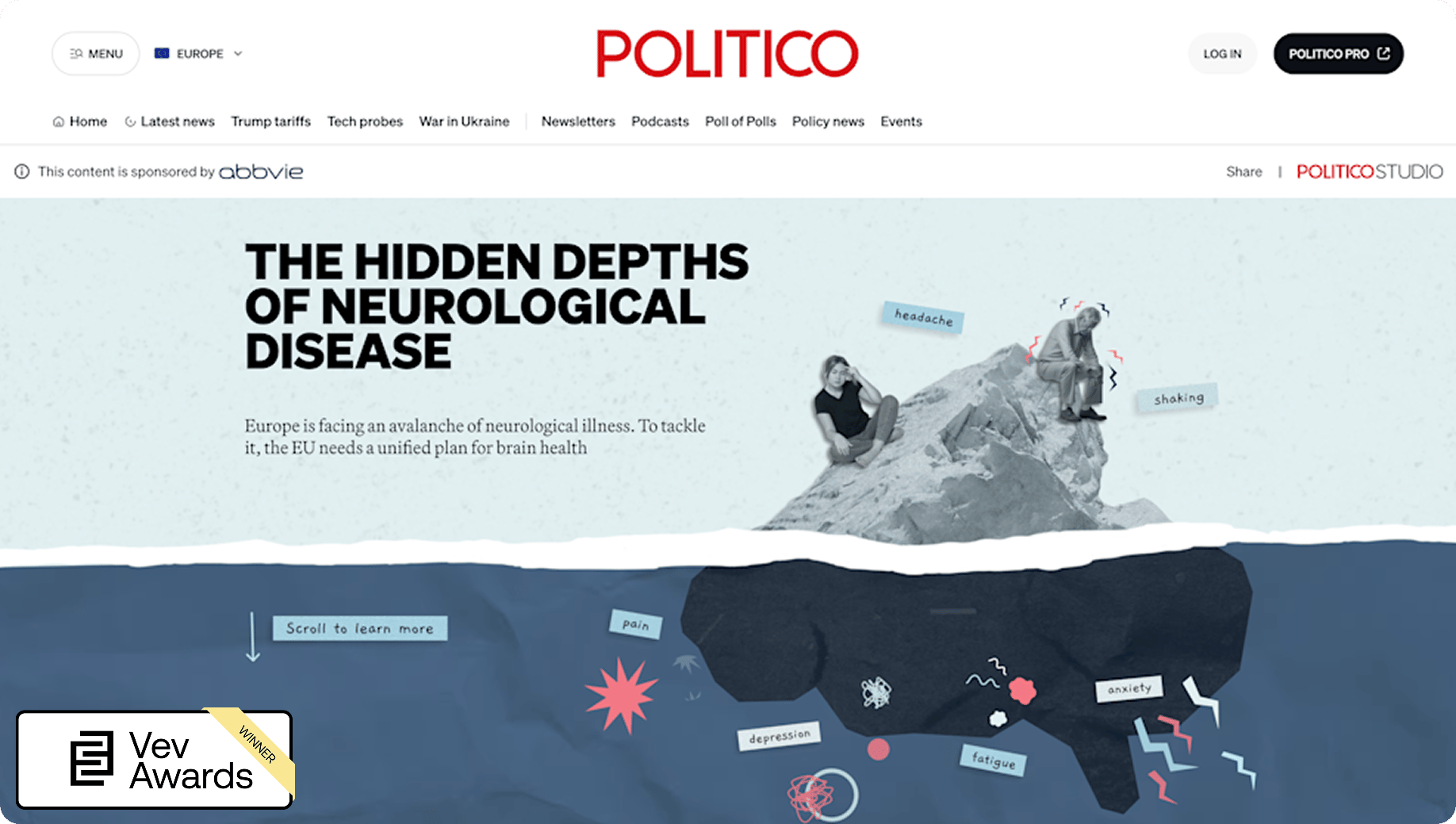
Winner: The Hidden Depths of Neurological Disease
What does it feel like to live inside a neurological condition?
That's the question at the heart of this month's winning project — an immersive article produced by POLITICO Studio and HLabs for AbbVie, exploring four neurological conditions: migraines, Parkinson's disease, stroke, and multiple sclerosis.
The brief was ambitious: raise awareness, build urgency, and lay the groundwork for real policy action — all within a sponsored content format, for a politically engaged, skeptical audience.
The result is one of the most considered pieces of branded editorial storytelling we've seen built in Vev.
Making a clinical topic feel human
Sponsored content often struggles with a fundamental tension: the subject matter is important, but importance alone doesn't earn attention.
The team at HLabs and POLITICO Studio resolved that tension through form as much as content. Rather than leading with data or statistics, the article puts readers in the presence of people who live and work with these conditions. Medical experts from across Europe speak directly to the reader — not through pull quotes, but through embedded audio clips that reward engagement and create a sense of genuine conversation.
The editorial structure gives each condition room to breathe, guiding readers through a layered narrative rather than a single argument.
A visual language built for depth
The design choices here are deliberate and distinctive.
Abstract imagery was used to suggest symptoms and sensations — the kind of experience that resists clinical photography — creating emotional resonance without reducing complex conditions to stock images of people in distress. A paper-cut, handmade visual style runs throughout: textured, layered, clearly human-made.
In an era when AI-generated visuals are increasingly the default, that quality feels intentional — and it reads that way to the audience.
Key design decisions that made this work:
Audio embeds let medical experts speak directly to readers, building credibility through voice rather than text alone
Abstract, non-literal imagery conveyed the subjective experience of neurological conditions without being reductive
A handcrafted visual language created a sense of craft and care that reinforced the seriousness of the subject
Scroll-driven pacing moved readers through a structured narrative, maintaining engagement across a complex, multi-condition topic
Results — and real-world impact
The numbers reflect what the design set out to do.
The article achieved 22% over benchmark for page views, with an average time on page of five minutes — strong indicators that readers weren't just landing on the page, they were staying with it. Engagement was particularly high among the Brussels-based audience and those working in and around the European Parliament: exactly the stakeholders the campaign needed to reach.
But the downstream impact may matter more than the metrics. The article's findings are now informing a stakeholder roundtable focused on policy action around neurological health — demonstrating that a well-executed interactive content piece can do more than perform well. It can become a tool for building community and driving change.
It's a compelling example of what's possible when publishers, agencies, and brands use interactive storytelling not as decoration, but as strategy.
Submit your Vev project to win next month
Get the credz you deserve and show off to industry peers by winning Vev's "Project of the Month" — the web design award where creativity matters.