
Scroll-Based Storytelling at Scale: How Publishers and Brand Studios Create Interactive Content Faster
March 31, 2026
Words by Vev
Scroll-based storytelling has become one of the most effective ways to turn static content into immersive digital experiences.
From editorial features to branded content campaigns, scrollytelling allows stories to unfold as users scroll—increasing engagement, time on page, and overall impact. But, for many enterprise teams, one challenge remains: How do you scale scroll-based storytelling without slowing down production?
We’ll explore the current challenges and pressures faced by teams tasked with creating this content, and how you can create scroll-driven digital stories in Vev with our Scrollytelling component, and scale it with Vev’s Libraries.
The real problem: high-impact content that doesn’t scale
Scrollytelling sits in an awkward place. In publishing and branded content teams, scroll-based storytelling is often seen as a premium format. Scrollytelling delivers strong results, like higher engagement, longer session times, and more compelling narratives.
Above: An example of a scrollytelling editorial "Welcome to Hunderfossen Winter Park" by Hunderfossen. Made in Vev.
But, it also comes with trade-offs, such as heavy reliance on developers and slow iteration cycles. This creates a bottleneck where the most effective format becomes the hardest to produce consistently. For many teams, scrollytelling has become a premium, one-off format.
Why this matters for publishers and branded content teams
For enterprise teams, this isn’t just a creative challenge — it’s an operational one, and a revenue constraint.
When scroll-based storytelling is difficult to produce:
- Fewer campaigns can be delivered at high quality
- Timelines become harder to meet, and limit how many campaigns can be sold
- Production costs increase, and these custom builds reduce margins on each project
At the same time, advertisers and audiences expect more:
- Interactive storytelling
- Visually engaging formats
- Seamless digital experiences
- Measurable engagement
The gap widens, between expectation and execution, but also between what’s possible and what’s practical to produce. Here’s the thing: it doesn’t need to be like this…
From custom builds to scalable systems
Traditionally, scroll-based storytelling relies on a mix of tools and libraries:
- Scroll-based animation libraries
- Custom JavaScript implementations
- Fragmented design and development workflows
While powerful, these approaches make it difficult to scale. Forward-thinking teams are shifting toward a different model: Turning scroll-based storytelling into a repeatable system—not a one-off project.
What scalable scroll-based storytelling looks like
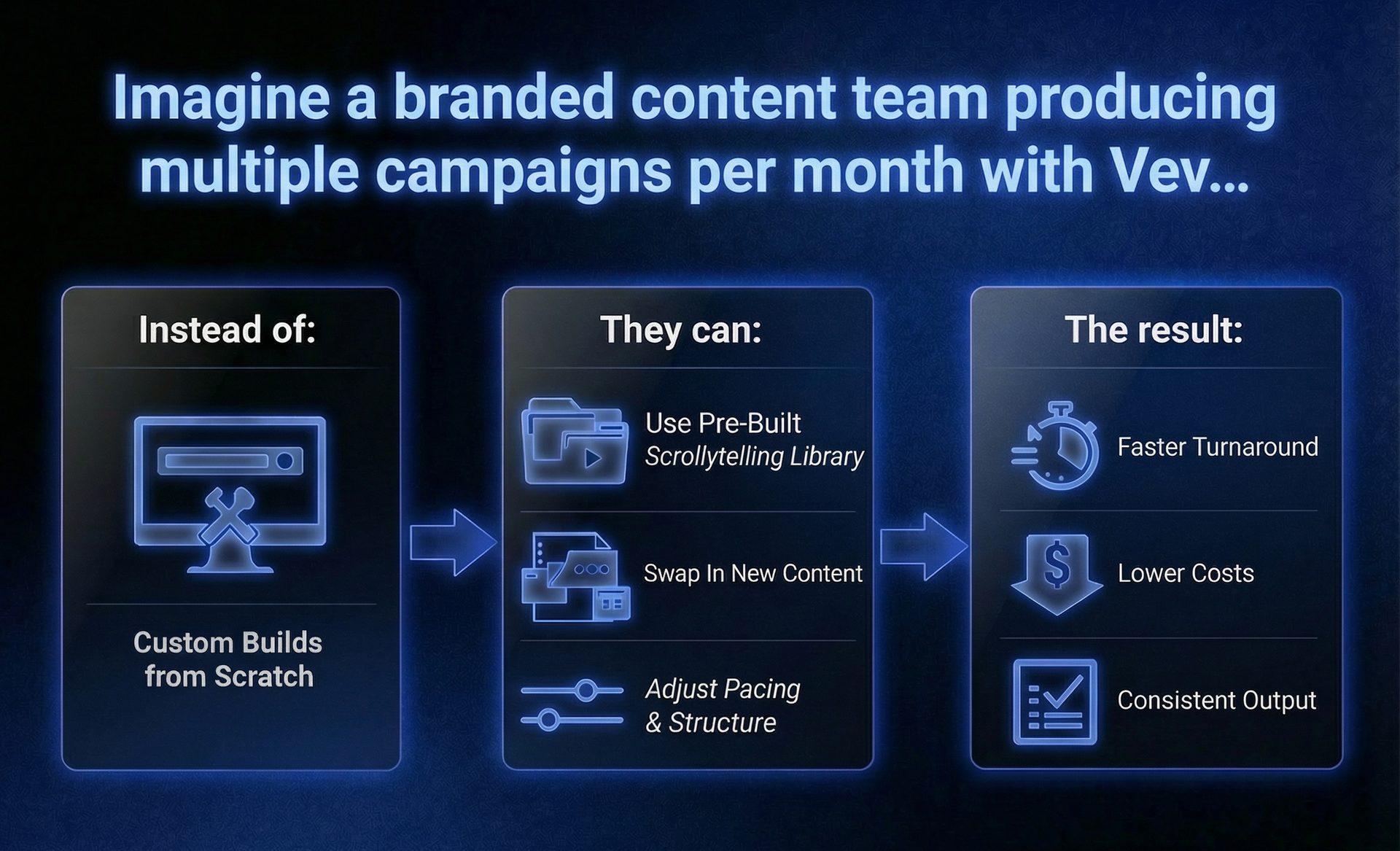
Instead of starting from scratch every time, teams publishing scrollytelling content every week are building reusable structures and workflows in Vev. This approach makes it possible to:
Build faster
Reduce reliance on custom development and speed up production timelines.
Reuse components
Create consistent, modular blocks that can be used across multiple projects.
Maintain quality at scale
Ensure every experience meets the same high standard, without extra effort.
Empower non-technical teams
Allow designers, marketers, and editors to create interactive content directly.
Scaling scroll-based storytelling with reusable libraries
One of the biggest challenges with scroll-based storytelling isn’t creating a single great experience — it’s doing it consistently, across teams and projects.
Even with the right tools, many teams still run into:
- Rebuilding similar sections from scratch
- Inconsistent design and interaction patterns
- Bottlenecks between design, editorial, and production
This is where libraries become essential.
From one-off builds to reusable systems
Instead of treating every scroll-based storytelling project as unique, teams can create pre-approved, reusable sections. Built once, then used many times. These can include:
- Scrollytelling sections with predefined transitions
- Structured layouts for long-form storytelling
- Branded components for campaigns and reports
How libraries improve publisher workflows
When scroll-based storytelling is paired with reusable libraries, production changes significantly:
Faster production
Teams can drop in ready-made scrollytelling sections instead of building from scratch.
Consistent quality and branding
Every experience follows the same design and interaction standards.
Better collaboration
Design teams create and approve components once — content teams reuse them freely.
Scalable output
More stories, campaigns, and reports can be produced without increasing workload.
4 common use cases for scroll-based storytelling
1. Editorial storytelling: Transform long-form articles into immersive experiences that keep readers engaged from start to finish.
2. Branded content and campaigns: Deliver high-impact storytelling for advertisers without treating every project as a custom build.
3. Product storytelling: Guide users through features visually, using scroll to reveal information step by step.
4. Reports and data storytelling: Make complex information easier to understand through interactive, structured narratives.
Get started with Scrollytelling at Scale
Watch our Scrollytelling tutorial
In this tutorial, you’ll discover how to build interactive content that responds to user scroll, using transitions like horizontal scroll, fade, and stacked effects. Learn how to use Vev’s Scrollytelling component to create immersive, scroll-driven storytelling experiences for the web.
👉 Documentation: Scrollytelling element
Learn how to use Libraries in Vev
Libraries are your team's "single source of truth", guaranteeing everyone builds with the latest approved designs. They allow you to save and reuse pages, sections, and components across all your projects, helping you and your teams scale consistently branded web content.
👉 Documentation: `Understanding Libraries
Best practices for high-performing scroll-based storytelling
To get the most out of this format, focus on structure as much as visuals:
Create a clear narrative flow
Each scroll should move the story forward in a logical way.
Use layering intentionally
Combine background and foreground elements to add depth without distraction.
Control pacing
Adjust scroll length and transitions to guide the reader’s experience.
Keep it purposeful
Every animation and transition should support the story, not overwhelm it.
The shift: from one-off projects to repeatable workflows
The biggest opportunity with scroll-based storytelling isn’t just better design. It’s better production. When you move from custom builds to reusable systems, you unlock:
- Faster turnaround times
- Increased output
- More consistent quality
- Greater return on content investment
Scroll-based storytelling is no longer just a “nice-to-have” format for big projects. It’s becoming a core part of how publishers and brand teams create interactive content. When combined with reusable libraries, it evolves from a creative technique into a scalable production system.
Going forward, the teams that succeed won’t just create great stories, they’ll build workflows that allow them to create more of them, faster.
Ready to scale your scroll-based storytelling?
If you’re looking to move from one-off projects to a repeatable, high-impact content workflow, it’s time to rethink how your team builds interactive experiences. By combining flexible Scrollytelling with reusable Libraries, you can produce more engaging content—faster, more consistently, and without added complexity.
Book a demo to see how your team can create and scale scroll-based storytelling with ease.